


REALISATION 43: ON FREEDOM
Author: Hoàng Nhật Minh
Views/Listens: 89
Created: 2026-04-06 23:00:12
Updated: 15:43pm 04/05/2026
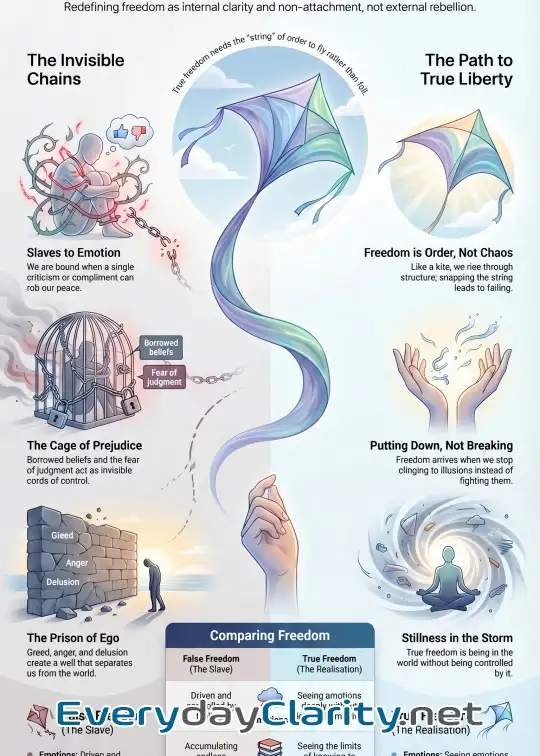
A kite rises high thanks to the string that holds it.
When the string snaps, it is not more free-it simply loses its bearings and falls.
True freedom is to fly within order, not to fly out of it.
1. We speak of freedom-but who is speaking?
Modern people love to talk about freedom: freedom of speech, freedom of belief, the freedom to live as one wishes.
But how many of us dare to ask: What, in me, is demanding freedom? And is the one demanding it truly free?
If the one demanding freedom is a bound ego, then every hunger for liberation is merely another layer of chains-gilded, but still chains.
2. Slaves to emotion
Emotion is a natural current in the mind. Yet when we do not see its true nature, we are swept away.
A compliment makes us float.
A criticism steals our sleep.
A trace of fear stops us from living.
A flare of anger makes us lose our capacity to love.
When we are no longer the master of our emotions, we are no longer free-because a single sentence from someone else can be enough to rob us of our peace.
Freedom is not the destruction of emotion; it is seeing deeply so that emotion no longer drives us.
Feelings may arise, but they no longer decide the direction of our life.
3. Slaves to prejudice and borrowed beliefs
From birth, society pours beliefs into us: you must be successful to have worth; you must be beautiful to be lovable; you must win to deserve respect.
These prejudices are like invisible cords, slowly tightening around the neck of the soul.
We fear being different because we fear judgement.
We choose silence because we fear exclusion.
We chase the mould because we believe that if we are not like everyone else, we will not be loved.
But living by prejudice is not living-it is merely existing inside the crowd's cage.
True freedom begins when we dare to question the beliefs that society treats as self-evident.
When we dare to live by direct experience, not by borrowed convictions.
4. Slaves to illness and the body
The body is the boat that carries us across the sea of life. Yet when we cling to it too tightly, we forget the one who is steering.
Some people spend their whole lives trying to keep the body young-while inside they are already rotting with fear.
Some fall ill and die, not from the body's sickness, but from despair.
Illness of the body is natural; illness of the mind is a choice.
What binds us is not disease itself, but the fear of disease.
Freedom is not having a perfect body; it is a mind that is not imprisoned by the body's limits.
5. Slaves to greed, anger, delusion, and pride
The three poisons-greed, anger, and delusion-are the oldest prison guards.
Greed makes us run without rest.
Anger makes us fight whatever displeases us.
Delusion makes us unable to see ourselves.
From there arises pride-the illusion that I am the centre of the universe.
And from that I, every conflict and suffering begins.
We build the wall of ego, then suffer because we feel separated from the world.
Yet in truth, the 'I' is only a wisp of smoke rising in the vastness.
When the ego dissolves, freedom appears-not the freedom of the inpidual, but the freedom of harmony with the whole.
6. Slaves to illusion-the darkness of intellect
We often imagine that knowing more will make us freer.
But if knowledge is only accumulation, without wakefulness, it becomes a new prison: the prison of conceptual thinking, the prison of the 'intellectual self'.
The more someone thinks they understand, the less they are able to see reality as it is.
The freedom of the intellect is not to know everything, but to see the limits of knowing.
Then the mind opens, no longer boxed in by prejudice or theory.
7. Freedom is not breaking things-it is putting them down
Freedom does not come from rebellion, nor from fighting to seize it.
Freedom arrives when we see clearly the nature of what binds us-and we no longer cling.
We do not need to run from emotion-only to see it arise and pass naturally.
We do not need to battle prejudice-only to stop identifying with it.
We do not need to destroy the ego-only to recognise it as an illusion.
When we see clearly, the rope unknots itself.
When we do not cling, the prison door opens.
8. Closing words: Freedom is stillness in the storm
Freedom is not out there-it is in the moment we wake up in the midst of our own turbulence.
It is not that the world changes; it is that we are no longer controlled by the world.
It is not that suffering disappears; it is that we see the nature of suffering clearly, and no longer fear it.
A free person can cry without being broken.
They can lose without feeling diminished.
They can live in the world without belonging to it.
That is a freedom no one can take away: inner freedom-the one thing truly worth seeking for an entire lifetime.
Hoàng Nhật Minh
Excerpt from the book: Spiritual Science - A Journey Back To Your True Self
| Previous Ebook | Next Ebook |
Tags: DestructionHungerSentenceThinksPrejudiceBorrowed
 Realisation 51: Understanding - The Source Of Love (Hoàng Nhật Minh)
 Realisation 52: Love - Letting Others Be Themselves (Hoàng Nhật Minh)
 Realisation 53: The Heart’s Evolutionary Journey (Hoàng Nhật Minh)
 Realisation 54: Living In Harmony With Nature (Hoàng Nhật Minh)
 Realisation 55: The Great Harmony Of The World - Humanity’s Shared Dream (Hoàng Nhật Minh)
 Part Vii - Attainment (Hoàng Nhật Minh)
 Attainment 01: The Journey From Knowing To Living (Hoàng Nhật Minh)