


PRACTICE 21: LOVING MOTHER EARTH
Author: Hoàng Nhật Minh
Views/Listens: 101
Created: 2026-05-04 13:50:40
Updated: 15:56pm 04/05/2026
I come from Mother Earth-breathing with the breath of the forests, drinking the clear water of streams, warmed by the Sun's light.
Each step I take is a thank you; each breath is a prayer.
I do not stand *on* the Earth-I am the Earth, walking.
Teach me to live gently, to protect and to love Mother as Mother has loved me from the very beginning.
1) Morning's greeting
In the early hours, sunlight touches the leaves like a whispered hello. Each breath entering the lungs is a priceless gift we so often forget to thank.
For millennia, this planet has nourished us: sweet water in underground veins, grains of rice across the fields, cool winds through valleys, and the salt of the sea carried even in a drop of sweat.
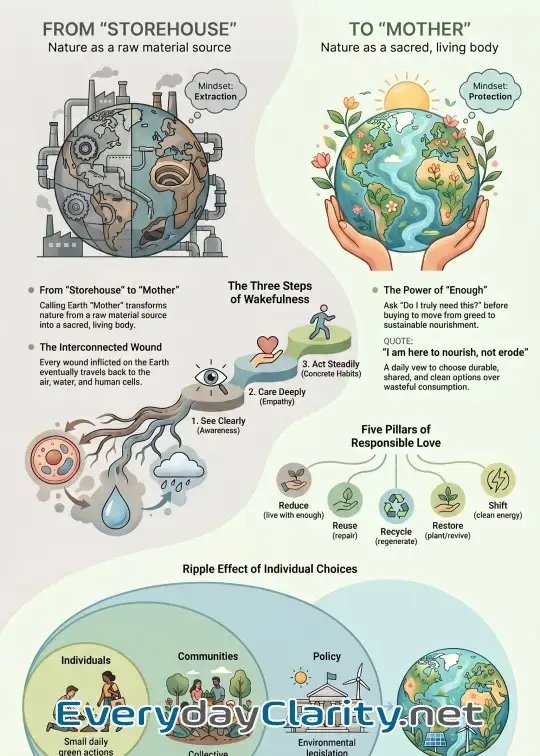
Yet most of the time we only take and do not give back. We extract more than we care for; we remove more than we return. And then, one day, we realise: every wound of the Earth travels back to us-in the water, in the air, in every cell of the human being.
2) The first lesson: call the Earth "Home", and "Mother"
When we call the Earth "Mother", the relationship becomes sacred and intimate. We stop seeing nature as a storehouse of raw materials, and begin to recognise it as a living body-the very body that shelters us.
We cannot bargain with the climate, trade with the forests, or postpone our responsibility to the oceans. We can only live in harmony-respecting the laws of balance in Mother Nature.
Change the name, and you change the way you look. Change the way you look, and you change the way you live.
3) Balance extraction with protection
Human beings need to eat, clothe ourselves, build homes, and create. So using resources is part of natural evolution.
The problem is not that we use, but how we use.
Unrestrained extraction turns resources into rubbish, forests into deserts, and the ocean into a dumping ground.
Limited, mindful use turns resources into a cycle-taking from somewhere, and returning to that same place.
Balance is not "stop". It is a question we bring to each action:
- Does this nourish the living system-or wear it down?
- If it wears it down, can I do it differently?
4) Wakefulness: from knowing to caring; from caring to action
Wakefulness is not a passing emotion. It is a three-step process:
- See clearly-recognise the link between personal behaviour and the ecosystem.
- Care deeply-feel the pain of the forests, the rivers, the soil.
- Act steadily-turn care into concrete actions: persistent, creative, and real.
5) Five pillars of responsible love
- Reduce-live with less, but enough; choose quality over quantity.
- Reuse-repair instead of throwing away; honour the usefulness of things.
- Recycle & regenerate-allow materials to return to a new cycle of life.
- Restore-plant trees, protect water sources, revive the soil.
- Shift-support clean energy, greener production, and sustainable transport.
Each pillar begins as a small habit-and can grow into a shared culture.
6) Ten small daily habits
- Buy less-use fully-love for longer.
- Carry a reusable bottle, a cloth bag, and a food container.
- Eat locally, eat seasonally, and choose sustainable foods.
- Walk, cycle, or use public transport.
- Save electricity-this too is a way of protecting nature.
- Sort waste-because "waste" is often only a resource in the wrong place.
- Spend five minutes a day touching nature: a plant pot, soil, or the open sky.
- Give time or income to local conservation projects.
- Inspire others through action-not speeches.
- Before buying anything, ask: Do I truly need this? Could I borrow it, repair it, or wait a little longer?
7) When inpiduals lead, systems change
- Schools: bring nature back into the classroom-learn by experience, not only by books.
- Cities: prioritise green space, walkways, cycle lanes, and public transport.
- Businesses: design for recyclability, make supply chains transparent, and reduce emissions in a real way.
- Policy: encourage clean energy, protect forests and rivers, and price environmental costs honestly.
- Communities: practise "zero-waste days", reduce plastics, prioritise recyclable materials, and organise regular clean-ups of canals, rivers, and beaches.
When inpiduals open a path → communities generate momentum.
When communities generate momentum → policy opens doors.
When policy opens doors → systems begin to transform.
8) Re-nourish our relationship with Earth, Water, Air, and Fire
- Earth: let the soil breathe; reduce chemicals; return organic matter. A handful of compost is a handful of hope.
- Water: drink slowly, use only what is needed, and return it clean. Today's drop is tomorrow's cloud.
- Air: saving energy is saving the city's breath.
- Fire (energy): learn to cook efficiently, avoid wasteful burning, and move towards clean sources.
No action is small-when it is repeated each day.
9) From guilt to gentle responsibility
Guilt about harming the Earth can awaken us-but only gentle responsibility can carry us far.
Look back without condemning yourself.
Correct your course without burning out.
Persevere without becoming extreme.
Gentle responsibility is the ethics of a new era-like tree roots: quiet, deep, and steady.
10) A small ritual: a vow to Mother Earth
Each morning, place a hand on your heart, take three deep breaths, and say silently:
*I am here to nourish, not to erode.
I will choose 'enough' so I do not become greedy;
'clean' so I do not contaminate;
'durable' so I do not break; and 'shared' so I do not pide.*
Then picture one specific green action-and do it before the sun sets.
A simple vow, repeated daily, can change the direction of an entire life.
11) Closing: learning to love our Mother planet
We do not inherit the Earth from our ancestors-we borrow it from our children.
When we learn to love a single leaf, we learn to love the whole forest.
When we learn to protect one drop of water, we learn to protect the river.
And when we are grateful for each breath, we become grateful for the entire sky.
In the end, whatever we do for Mother Earth-we do for ourselves.
Begin today: with one small choice, one lighter step, one tender gaze towards the place we call Home.
Hoàng Nhật Minh
Excerpt from the book: Spiritual Science - A Journey Back To Your True Self
| Previous Ebook | Next Ebook |
Tags: GreenerGreetingPillarsResourcesMaterialsForests
 Realisation 01: On Racial Discrimination (Hoàng Nhật Minh)
 Realisation 02: On Religious Discrimination (Hoàng Nhật Minh)
 Realisation 03: On Gender And The Roles Of Men And Women (Hoàng Nhật Minh)
 Realisation 04: On Good And Evil (Hoàng Nhật Minh)
 Realisation 05: On Vegetarian And Non-Vegetarian Eating (Hoàng Nhật Minh)
 Realisation 06: On Money And The Currency Of Happiness (Hoàng Nhật Minh)
 Group 2: Realisations On The Human Condition (Hoàng Nhật Minh)