


PRACTICE 23: GIVING - DĀNA
Author: Hoàng Nhật Minh
Views/Listens: 103
Created: 2026-05-04 13:58:14
Updated: 15:56pm 04/05/2026
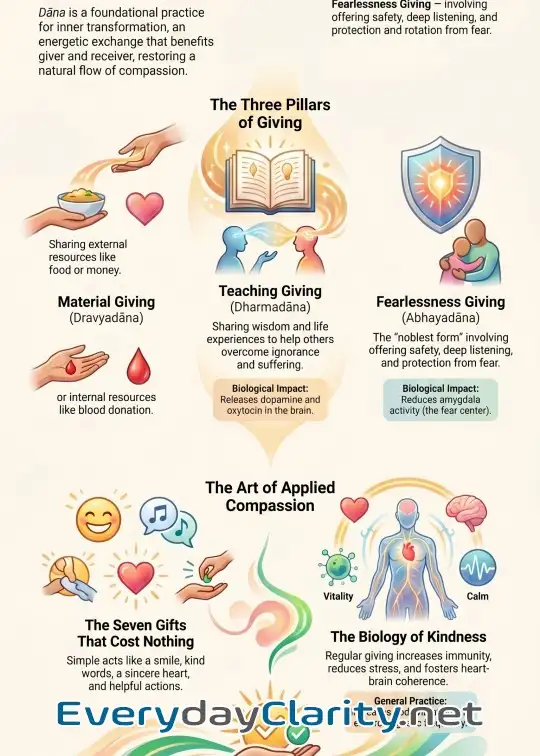
When the hand opens to give, the heart opens to receive.
1) The meaning of giving on the spiritual path
In every great wisdom tradition, giving is a starting point for inner transformation. In Buddhism, giving (Dāna) is not merely the act of donating; it is a method for cleansing greed, ego-clinging, and fear.
When we give, we loosen the grip of the self that is always holding on. And when we give with truly unconditional love, we touch the frequency of compassion.
At the deepest level, the giver no longer perceives a giver, a receiver, or an object given. In that moment, giving becomes the Way.
Giving does not only ease another person's suffering; it also opens the flow of energy within us. Like water: if it is kept back, it stagnates; if it moves, it becomes clear. Love-energy is the same-only by giving does it multiply.
2) The three most common forms of giving (Mahayana teaching)
2.1) Material giving (*Dravyadāna*) - sharing resources
This is the most familiar form: sharing what we have so another can step out of lack. It may be money, food, medicine, clothing, shelter-or simply a meal, or a bottle of water on a hot day.
Branches:
- Outer giving: offering external possessions.
- Inner giving: offering the body (blood, organs-even the willingness to sacrifice one's life) for the benefit of beings.
From the lens of energy science: when we give, the heart's vibration of gratitude and compassion is activated, increasing the frequency of the body's electromagnetic field and radiating outward.
It becomes a resonance from heart to heart: a single wholesome act can contribute to a shared field of healing.
2.2) Teaching giving (*Dharmadāna*) - sharing wisdom
This is giving the light of understanding-helping others suffer less through ignorance. It may be teaching the Dharma, writing, sharing life experience, guiding meditation, or simply offering the right counsel at the right time so someone can see their path.
To light another's lamp is also to brighten one's own.
In the information age, teaching giving can also mean sharing useful knowledge, educating for kindness, and raising community awareness.
From a neuroscience perspective: when we help someone understand, the brain releases dopamine and oxytocin, creating a sense of peace and deep connection-the joy of wisdom.
2.3) Fearlessness giving (*Abhayadāna*) - offering safety
This is the noblest form: bringing peace of mind and relieving fear. Sometimes it means rescuing someone in danger, protecting the vulnerable, offering comfort, listening deeply, or helping create a safe and decent environment.
When you help someone become unafraid, you have lit a torch of love in the darkness of ignorance.
From a psychological perspective: when we help others feel safe, activity in the amygdala (the fear centre) reduces, while the prefrontal cortex (reasoning and positive emotion) becomes more active. In other words, fearlessness giving can be profound emotional therapy.
3) Seven forms of giving that cost nothing (the "Seven Gifts")
The Buddha once taught a poor person:
Not only the rich can give.
Anyone with a wholesome heart can give.
And he pointed to seven kinds of giving that require no money-yet are of immeasurable value:
- A warm face: giving through a smile and a bright, gentle expression.
- Kind speech: giving through compassionate, encouraging words.
- A true heart: giving through sincerity and gratitude.
- Gentle eyes: giving through a soft, respectful gaze.
- Helpful action: giving through practical assistance.
- Offering a seat: giving through yielding and consideration.
- Giving shelter: giving through refuge and broad-heartedness.
These seven gifts are the art of applied compassion. No money. No ceremony. Only a heart that is willing to open.
4) Giving - a path of energetic transformation
Giving is not only ethics; it is an energy practice.
Each time we give, the body's vibration rises. As greed, fear, and selfishness dissolve, the heart and brain begin to synchronise (heart-brain coherence), generating a field of compassion that affects even the surrounding environment.
Compassion is among the most powerful healing energies in the Universe.
People who practise giving regularly often have stronger immunity, less stress, and longer lives-one expression of the biology of kindness (biopsychosocial healing).
5) Practising giving in modern life
Small daily practice:
- Each morning, make a vow: Today, I will give at least one good thing.
- When you see someone suffering, do not rush to judge-offer a look of understanding.
- When you see others succeed, rejoice sincerely-that is heart-giving.
- When someone makes a mistake, instead of anger, offer fearlessness-giving: empathy.
Collective practice:
- Organise volunteer days, blood donation drives, or knowledge-sharing circles.
- Create spaces of "shelter-giving"-places where people can rest, learn meditation, or simply feel heard.
Spiritual practice:
- In meditation, visualise sending loving energy in all directions.
- Pray that all beings may be safe, at peace, and free from suffering and fear.
When genuine giving arises in your heart, you become a channel for great compassion.
6) Give in order to return
When we give, we do not truly lose anything. We are simply restoring the Universe's natural circulation.
Giving is a way back to oneness-because giver, receiver, and gift are, in the end, expressions of the same life. To give is a gentle dissolving of the ego, opening the door to liberation from the feeling of lack.
And in the very moment we offer something away, we are filled-quietly, abundantly-with limitless light.
Hoàng Nhật Minh
Excerpt from the book: Spiritual Science - A Journey Back To Your True Self
| Previous Ebook | Next Ebook |
Tags: DonationSurroundingVolunteerBenefitSelfishnessCommunity
 Practice 03: Dynamic Meditation - The Path Of Healing Through Action (Hoàng Nhật Minh)
 Practice 04: Living Meditation - The Middle Way (Hoàng Nhật Minh)
 Practice 05: Eating To Balance Yin And Yang (Hoàng Nhật Minh)
 Practice 06: Awakening The Cells (Hoàng Nhật Minh)
 Practice 07: Listening To Healing Music - Frequency Music (Hoàng Nhật Minh)
 Group 2: Heart - Listening, Contemplation, And Purification (Hoàng Nhật Minh)
 Practice 08: Insight Meditation (Hoàng Nhật Minh)