


REALISATION 32: ON THE DAO - EMPTINESS - THE INVISIBLE GROUND OF ALL THINGS
Author: Hoàng Nhật Minh
Views/Listens: 111
Created: 2026-04-06 23:00:11
Updated: 14:58pm 04/05/2026
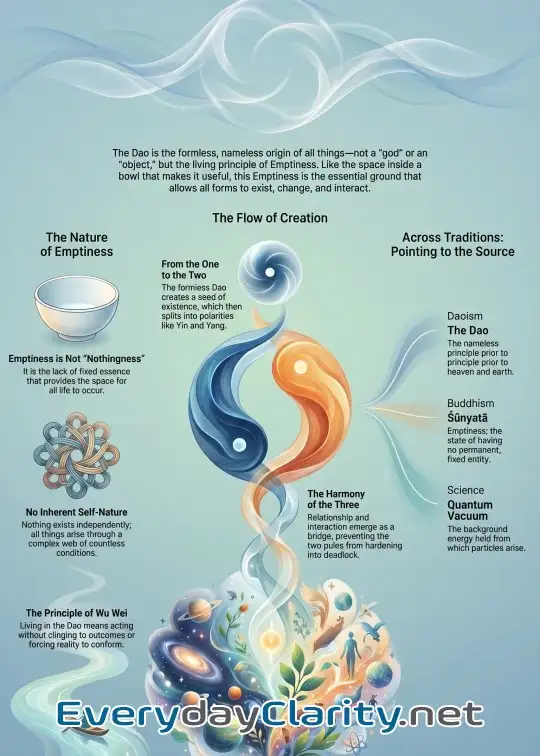
A seeker asked a Zen master:
- 'Where can I see the Dao?'
The master lifted an empty bowl:
- 'It is this very space that holds everything-and makes the bowl useful.'
Emptiness is not nothingness; it is the ground of all existence.
1) The Dao before every beginning
'The Dao gives birth to One; One gives birth to Two; Two gives birth to Three; Three gives birth to the ten thousand things.'
*(Dao De Jing, Chapter 42)*
When Lao Tzu spoke of the Dao, he was not trying to name a god, nor an object. The Dao is his way of pointing to an invisible origin-something that cannot be named, and yet gives rise to everything that can be named.
The Dao does not begin at a point, nor end anywhere. It is not a thing, not an idea, not a being standing outside the universe and watching. It is the living principle-Emptiness itself-the foundation from which all phenomena arise.
2) Emptiness is not 'nothing'
Many people hear the word emptiness and immediately think of hollowness or loss. But in Eastern wisdom, Emptiness (Śūnyatā) is not non-existence. It means:
- No inherent self-nature: nothing exists independently; everything comes into being through countless conditions.
- No fixed essence: all forms change; there is no permanent entity hidden inside.
- No obstruction: because we are not clinging to a fixed form, Emptiness can receive and reveal every phenomenon.
One could say: it is precisely because there is Emptiness that there is room for all form. Like the space inside a jar that allows it to hold water; like the space in a room that makes living possible. Without that space, those things would, in a sense, be useless.
3) The Dao and the arising of the Two, the Three, and the ten thousand things
- The Dao gives birth to One: from quiet, formless stillness, the first principle appears-the seed of existence.
- One gives birth to Two: from the silent ground arise polarities: yin and yang; stillness and movement; subtle and manifest. Duality gives the world its current-its pulse and flow.
- Two gives birth to Three: from the two poles emerges the principle of relationship and harmonisation-interaction, the linking current of life. The Three is the bridge that prevents the Two from hardening into deadlock.
- Three gives birth to the ten thousand things: from that harmony, the world of innumerable forms comes to be.
Yet though all things arise and pass away, the Dao remains like a calm sea beneath the waves-neither increased nor diminished.
4) The Dao within the human being
In ordinary life, the Dao is not distant. It reveals itself in every breath, every movement, every joy and sorrow.
When the mind becomes still like an autumn lake, we see thoughts for what they are: ripples on the surface. The Dao is that quiet space-the stillness in which emotions and ideas arise and fade.
One who understands the Dao does not try to possess it, nor force life to conform. They move with the stream of reality, acting without clinging to outcomes-what Lao Tzu called wu wei.
Living joyfully with the Dao, follow conditions as they come.
Hungry-eat. Tired-sleep.
In your own house there is treasure-stop searching outside.
Facing the world with an ungrasping mind, do not ask about Zen.
*(Trần Nhân Tông)*
5) The Dao and inner freedom
Recognising the Dao-Emptiness-does not turn us into people who escape life. On the contrary, it helps us:
- Be free of opposites: no longer tossed between like and dislike; success and failure; winning and losing.
- Live in harmony with all beings: seeing that everything arises from the same ground.
- Be fully present: not imprisoned by the past, not dragged by the future.
When the Dao is seen, there is no need to seek support outside-because that boundless openness is itself the foundation that holds everything.
6) Conclusion
Oneness, duality, and the triad are viewpoints the human mind uses to understand the world. Yet all of them appear within the Dao, like waves rising on the sea.
The Dao is not a theory to grasp, but a truth to recognise directly. When it is recognised, one sees clearly:
- All arising and passing is like clouds drifting by-yet the sky itself never changes.
Nature is Heaven's way: when we do not calculate and scheme, life becomes peaceful.
7) Names for the Dao / the Ultimate Source
A) In spiritual and religious traditions
- Hinduism: Brahman - absolute reality: invisible, unborn, undying.
- Buddhism: Śūnyatā (Emptiness) - no inherent self-nature; not fixed; beyond birth and death.
- Also spoken of as the Dharma-realm, the Tathāgata-garbha, or Suchness.
- Daoism: Dao - the mysterious principle; 'nameless, prior to heaven and earth'.
- I Ching: Wuji - the state before yin and yang; before the movement of transformation.
- Christianity: God the Father - the creative source, beyond form.
- Sufism (Islamic mysticism): Al-Ḥaqq (the Real) - absolute being, ultimate truth.
- Sikhism: Ik Onkar - the One Supreme Reality.
B) In Western philosophy
- Heraclitus: Logos - the ordering principle of the cosmos.
- Plato: The One - the ground of all modes of being.
- Plotinus (Neoplatonism): The One / The Good - beyond all qualities.
- Spinoza: Substantia - God as Nature itself.
- Hegel: Absolute Spirit - consciousness unfolding through history.
- Schopenhauer: Will - the blind drive behind appearance.
C) In modern science and cosmology
Science does not treat this as a pine entity. Yet when it traces matter, energy, and space back towards their origin, it meets concepts that play a similar role:
- Quantum vacuum - a background energy field from which particle-antiparticle pairs may arise.
- Unified field - the hypothesis of a single foundation unifying the fundamental forces.
- Cosmic singularity - the state 'before' the Big Bang, where spacetime as we know it is not yet present.
- Quantum fluctuations / the universal wave function - a probabilistic ground for the appearance of matter.
D) In esoteric and indigenous traditions
- Ancient Greek thought: Apeiron - the limitless, unpided.
- Lao-Zhuang tradition: Mystic Unity, the deepest mystery.
- Australian Aboriginal tradition: Dreaming / Dreamtime - the primal dream-reality.
- Native American tradition: Great Spirit - a life-force permeating the universe.
- Shinto: Kami as local expressions of an all-pervading spiritual power.
In summary
Although the names differ:
- Religion often uses personal language (the Father, the Great Self, the Great Spirit).
- Philosophy uses abstract language (the One, Substance, the Absolute).
- Science uses physical language (quantum vacuum, singularity).
All are pointing towards a ground beyond form-where the split between matter and mind, being and non-being, sacred and ordinary, falls away.
As Lao Tzu said:
'The Dao that can be spoken is not the eternal Dao; the name that can be named is not the eternal name.'
Hoàng Nhật Minh
Excerpt from the book: Spiritual Science - A Journey Back To Your True Self
| Previous Ebook | Next Ebook |
Tags: EsotericDriftingDreamingPermanentSupremeTraces
 Practice 24: Living Fully In The Law Of One (Hoàng Nhật Minh)
 Group 5: Awakening - Returning To The Inner Source Of Light (Hoàng Nhật Minh)
 Practice 25: Living Awake In Everyday Life (Hoàng Nhật Minh)
 Practice 26: Living Fully, Moment By Moment (Hoàng Nhật Minh)
 Practice 27: Communicating Through Consciousness (Hoàng Nhật Minh)
 Practice 28: The Art Of Letting Go (Hoàng Nhật Minh)
 Practice 29: Reconnecting With Your Inner Child (Hoàng Nhật Minh)