


CHAPTER 12: THE NEUROSCIENCE OF CONSCIOUSNESS
Author: Hoàng Nhật Minh
Views/Listens: 97
Created: 2026-04-05 18:44:31
Updated: 14:50pm 04/05/2026
Electricity and the lightbulb
The lightbulb boasted:
Because of me, there is light!
Electricity smiled:
If I did not flow through you, you would only be an empty shell.
Consciousness is the current; the brain is the instrument through which it appears.
1. The brain - a gateway between matter and consciousness
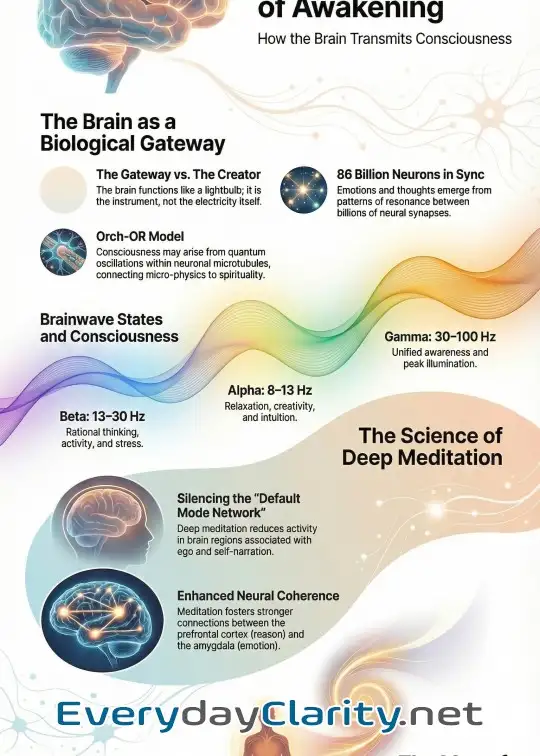
Human beings once believed consciousness was merely a by-product of brain activity. But recent neuroscience suggests the opposite: the brain does not create consciousness-it transmits and expresses it, like a radio receiving a signal from a greater source.
The brain contains around 86 billion neurons. Each connects to thousands of others through synapses, forming a network more complex than a galaxy.
As electrical impulses and neurotransmitters interact, emotions, memories, intuition, and thought emerge.
The miracle is not the cells themselves, but the patterns of oscillation and resonance between them.
Each state of consciousness-joy, sadness, fear, wakefulness-corresponds to different brainwave frequencies:
- Beta (13-30 Hz): activity, stress, rational thinking
- Alpha (8-13 Hz): relaxation, creativity, intuition
- Theta (4-8 Hz): deep meditation, the subconscious
- Delta (0.5-4 Hz): deep sleep, restoration
- Gamma (30-100 Hz): unified awareness, peak illumination
Neuroscientists call these the rhythms of consciousness-where biology touches the mystical.
2. The rise of the Science of Wakefulness
Research by Richard Davidson (University of Wisconsin), Andrew Newberg (Pennsylvania), and Tara Swart (MIT) indicates:
- Meditation and compassion can reshape the brain (neuroplasticity).
- The prefrontal cortex (reason) connects more coherently with the amygdala (emotion).
- Gamma waves increase strongly in long-term meditators, especially in states of unified consciousness.
When a person meditates deeply, the brain reduces activity in the Default Mode Network-often associated with ego and ceaseless self-narration.
When the DMN grows quiet, the natural sense of "I and the world are one" can arise.
This is not myth-it is neuro-experimental evidence of awakening.
3. Consciousness - an ocean, with the brain as ripples
One of today's greatest scientific challenges is the hard problem of consciousness: why do physical processes give rise to subjective experience?
No equation explains what pain feels like, or happiness, or love.
This has led scientists such as David Chalmers, Roger Penrose, and Stuart Hameroff to suggest:
Consciousness is not located in the brain; rather, the brain is a device that interfaces with a universal field of consciousness.
They propose the Orch-OR (Orchestrated Objective Reduction) model, suggesting consciousness arises from quantum oscillations within neuronal microtubules-where micro-physics meets the vastness of spirituality.
If so, consciousness is the foundational energy field-akin to knowing nature in Buddhism, inner radiance in Taoism, or spirit-breath in Biblical language.
4. When science meets meditation
fMRI studies show that when meditators reach deep stillness, the brain does not stop functioning. Instead, it enters a higher order-like an orchestra perfectly in tune.
Motor, emotional, and rational regions can oscillate in coherent synchrony.
This is the meeting point of energy and consciousness, physics and spirituality.
The neuroscience of consciousness thus becomes not merely a study of the brain, but a map of awakening:
- recognising emotion (body awareness)
- observing thought (heart awareness)
- seeing the one who is observing (mind awareness)
- merging into pure knowing (soul awareness)
Then science and meditation are no longer opposites; they are two languages of one truth.
5. From neurons to Nirvana
The brain is the vehicle. Consciousness is the current. Love is the light that shines through that current.
When we understand the structure of the brain, we no longer see awakening as something mystical.
When we understand the nature of consciousness, we realise that every neuron is a doorway into the spiritual.
And when we understand the unity of matter, energy, and consciousness, we recognise what the enlightened ones have said for thousands of years:
One who knows themselves is one who has known the universe.
Conclusion of Part III
When science reaches its furthest edge, it becomes spirituality.
When spirituality is understood correctly, it is pure science.
Both move towards one truth: love-and union.
When wisdom and compassion meet, science becomes the path, and spirituality becomes the light.
Hoàng Nhật Minh
Excerpt from the book: Spiritual Science - A Journey Back To Your True Self
| Previous Ebook | Next Ebook |
Tags: EquationAssociatedProcessesOrchestraBiblicalChallenges
 Reflection 05: Adversity And Liberation (Hoàng Nhật Minh)
 Reflection 06: Only After Losing It Do We Appreciate What We Had (Hoàng Nhật Minh)
 Reflection 07: The Three Foundations Of True Wellbeing (Hoàng Nhật Minh)
 Reflection 08: Education As Light (Hoàng Nhật Minh)
 Level 2: Transformation (Hoàng Nhật Minh)
 Reflection 09: Transforming Karma (Hoàng Nhật Minh)
 Reflection 10: Fear - The Mind’s Illusion (Hoàng Nhật Minh)