


PRACTICE 14: A POSITIVE PERSPECTIVE - POSITIVE THINKING
Author: Hoàng Nhật Minh
Views/Listens: 100
Created: 2026-05-04 11:08:53
Updated: 15:55pm 04/05/2026
When you change the way you look at things, the things you look at change. - Wayne Dyer
1) From negative to positive: a journey of awareness
Every day we face hundreds of situations that can unsettle the mind: someone's words, a failure, or an unexpected turn of events. Our instinct is to resist or complain. Yet when awareness deepens, we begin to see a simple truth:
It is not the world that makes us suffer, but the way we interpret the world.
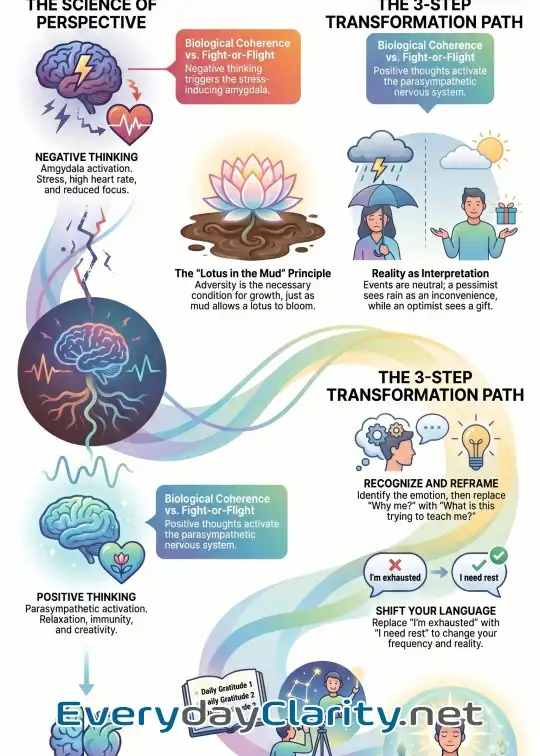
A pessimist sees the rain as an inconvenience; an optimist sees it as a gift for the trees and grass. The scene is the same-only consciousness has shifted.
This is the starting point of positive thinking: the ability to recognise light in the middle of darkness.
If you can find the most constructive meaning within the most difficult circumstance, you begin to glimpse the Way. Sometimes everything seems to contradict everything else-but that, too, can be the Way.
2) The science behind positive thinking
Modern neuroscience suggests:
- A positive thought activates the parasympathetic nervous system, helping the body relax and supporting immunity and creativity.
- Negative thinking activates the amygdala-the fight-or-flight centre-raising the heart rate, increasing stress, and reducing the ability to focus.
Research associated with Harvard and the HeartMath Institute indicates that gratitude, love, and optimism can synchronise brainwaves and heart rhythm, creating a state of biological coherence.
In other words, positive thinking is not daydreaming. It is a balanced energetic state-one that helps us harmonise with the universe's larger field.
3) Practising a positive perspective
To develop positive thinking, we do not need to deny negative emotions. We learn to transform them.
Step 1: Recognise the emotion
When you feel angry, sad, or disappointed-pause and observe. Simply say inwardly: I'm feeling sad. That awareness is the first ray of light entering the dark.
Step 2: Change the question
Instead of asking, Why is this happening to me? ask:
- What is this trying to teach me?
- How can I grow through this experience?
Change the question, and you change the flow of energy.
Step 3: Shift your language-change your frequency
Thought and speech share the same energetic nature.
- Don't say: I'm exhausted. → Say: I need a little rest.
- Don't say: I'm afraid of failure. → Say: I'm learning how to do this better.
Language creates reality. Speaking differently is living differently.
Step 4: Practise gratitude in the everyday
Each day, write down three things you feel grateful for. Even small things-a smile, a cup of tea, a quiet morning-are enough to let positive energy fill you.
Gratitude is one of the strongest fields for transforming the mind.
Step 5: Aim the mind towards what is good
When you face difficulty, imagine your future self-the version of you who has already made it through. Ask: What would the better version of me do?
This imagination is a kind of inner 'quantum' action: it helps the brain shape a positive outcome before it arrives.
4) Positive thinking is not denying suffering
Some people misunderstand positive thinking as pretending to be cheerful. It is not.
A positive perspective means looking directly into the dark-without allowing the dark to define you.
When you can recognise the hidden meaning inside adversity, suffering becomes material for awakening.
A lotus blooms only in mud. The mud is not 'bad'; it is simply the condition that allows the flower to open.
5) Crystallisation: living with a creative mind
A person with a positive mind does not merely 'think good thoughts'-they act from clear understanding.
- Instead of judging, they understand.
- Instead of reacting, they respond with wisdom.
- Instead of fearing, they choose trust.
They become a co-creator with the universe, rather than a victim of circumstance.
6) Closing words
When we change our perspective, the whole universe seems to smile back.
Remember: positive thinking is not a skill-it is a way of living. It is the way we choose to see the world, and the way we speak lovingly to ourselves each day.
The sun never goes out; it is only that we have turned our backs to the light.
Hoàng Nhật Minh
Excerpt from the book: Spiritual Science - A Journey Back To Your True Self
| Previous Ebook | Next Ebook |
Tags: ConstructiveImmunityImaginationInstituteTurnedHarvard
 Realisation 39: Everything Is Light (Hoàng Nhật Minh)
 Group 6: Awakening After Union - The Natural Way Of Living (Hoàng Nhật Minh)
 Realisation 40: On The Soul (Hoàng Nhật Minh)
 Realisation 41: The Soul’s Perspective (Hoàng Nhật Minh)
 Realisation 42: Love Hidden Behind Wounds (Hoàng Nhật Minh)
 Realisation 43: On Freedom (Hoàng Nhật Minh)
 Realisation 44: On Independence, Freedom, And Happiness (Hoàng Nhật Minh)