


CHAPTER 5: FROM INSTINCT TO WAKEFULNESS
Author: Hoàng Nhật Minh
Views/Listens: 99
Created: 2026-04-05 18:44:30
Updated: 14:48pm 04/05/2026
The fish and the water
A little fish asked its mother:
Mum, where is the water?
The mother smiled:
You're in it.
The little fish was astonished:
But I can't see it!
Because you've never been outside it, you think it doesn't exist.
The next day, the little fish was thrown onto the shore by a wave. In the moment of suffocation, it finally understood what water was… and what life was.
Human beings are the only creatures able to know that they are alive-and also the only creatures able to forget it.
1. Three steps of life
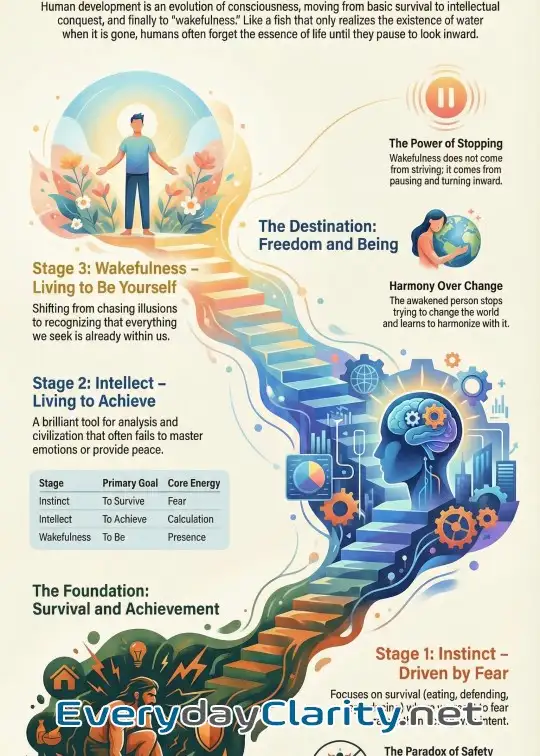
If we look closely, humanity's development is not only physical evolution, but the evolution of consciousness. Human awareness passes through three main stages:
- - Instinct - living to survive
- - Intellect - living to achieve
- - Wakefulness - living to be yourself
Each stage is necessary; it is a rung on the ladder that helps us climb higher. Without instinct, we cannot survive. Without intellect, we cannot develop. Without wakefulness, we cannot be free.
2. The instinct stage - when fear drives us
Instinct is the lowest layer, yet often the strongest. It is programmed for survival: eating, sleeping, defending, reproducing.
Living in instinct, we react more than we act.
A loud sound makes the heart race. A judgemental glance makes us shrink back. We are controlled by the fear of loss, of being hurt, of dying.
Fear is the most powerful energy at the instinct level-and it still influences much of humanity today. People do not live to enjoy; they live to feel safe. Yet paradoxically, the more we seek safety, the more fearful we become.
3. The intellect stage - when we start conquering
As intelligence develops, we enter the age of intellect. We learn to analyse, calculate, measure, compare.
The intellect is a magnificent tool; it has enabled a brilliant civilisation.
But when intellect is not guided by wisdom, it turns us into people controlled by our own minds. The intellectual person may know how to make money, but not how to live in peace. They may know how to dominate others, but cannot master their own emotions.
That is why, in a world of conveniences, we still see depression, loneliness, and a loss of direction.
4. The wakefulness stage - when we begin to remember
Wakefulness is when we begin to see ourselves-seeing thoughts and emotions, and recognising that we are not them.
Wakefulness does not come from striving; it comes from stopping.
When we become weary of chasing illusions, we pause and turn inward. Then we recognise:
Everything we have been seeking has always been here within us.
The awakened person no longer lives to achieve, but to be present. No longer trying to change the world, they learn to harmonise with it.
From instinct → intellect → wakefulness is the journey back to a peaceful heart.
Wakefulness is not doing something extra-it is stopping the forgetting of who you are.
Hoàng Nhật Minh
Excerpt from the book: Spiritual Science - A Journey Back To Your True Self
| Previous Ebook | Next Ebook |
Tags: BrilliantGlanceForgettingIntellectualRememberPeaceful
 Reflection 10: Fear - The Mind’s Illusion (Hoàng Nhật Minh)
 Reflection 11: When The Mind Reacts To Outer Circumstances (Hoàng Nhật Minh)
 Reflection 12: Before Practice, We Cling In Worldly Ways; After Practice, We Cling In Spiritual Ways (Hoàng Nhật Minh)
 Reflection 13: The Law Of Balance (Hoàng Nhật Minh)
 Reflection 14: Wealth Is A Contented Heart (Hoàng Nhật Minh)
 Reflection 15: Acting Without Attachment (Hoàng Nhật Minh)
 Reflection 16: One Who Has Healed-There Is Nothing They Cannot Say (Hoàng Nhật Minh)