


PRACTICE 29: RECONNECTING WITH YOUR INNER CHILD
Author: Hoàng Nhật Minh
Views/Listens: 88
Created: 2026-05-04 14:13:28
Updated: 15:57pm 04/05/2026
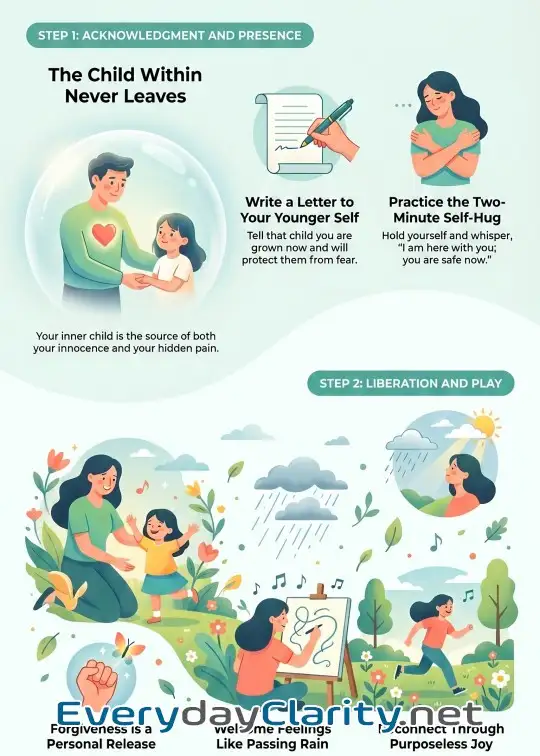
1) That child has never left
No matter how grown-up you are, no matter how many years you have travelled through, there is still a small child living inside you, waiting to be heard.
That child is the part of you that is clear, innocent, able to trust and to love without condition. And that same child is also the part that has been hurt, judged, abandoned, forgotten.
Whenever you feel angry, afraid, lonely, or "not good enough", it is that inner child speaking.
That is why healing does not begin by changing the world. It begins by returning to hold your inner child.
2) When the adult forgets how to love
We grow up inside moulds: be strong, be capable, be good. We learn to hide our tears and our fear. We put on an adult mask and forget the cry we once had.
But the inner child never forgets. It is still there-waiting for you to come back, waiting for a hug, waiting for words like these:
It's all right. I understand. You don't need to be perfect. You only need to be yourself-and that is enough.
If no one has ever said that to you, say it to yourself today.
3) Practical exercise: write a letter to the child in you
Find a quiet place. Take a few deep breaths, place a hand on your chest, and imagine you are sitting in front of your younger self.
Write a letter to that child-no rules, no need to be "right"; only be real.
Tell them:
- I'm sorry I left you alone for so long.
- I know you were in pain, you were scared, you felt unworthy.
- I'm grown now, and I will protect you.
Let the tears fall if they want to. That is not weakness; it is the sign of melting. Tears are a pathway through which wounded energy can be released.
4) Welcome your feelings instead of denying them
When you are hurt, do not try to extinguish the feeling. Do not tell yourself, I shouldn't be sad, or I must be strong.
Instead, say:
I am sad-and that is normal.
Welcoming an emotion does not mean sinking into it. It means allowing it to pass through you, as rain passes through the sky.
Feelings are like energy: they only want to be acknowledged so they can dissolve.
5) Practical exercise: hold yourself
Each day, for just one or two minutes, practise holding yourself.
Place a hand on your chest and whisper:
I'm here with you. You're safe now. I love you-whoever you are, whatever you're feeling.
At first it may feel strange. But trust this: love is a language every soul understands.
Each hug you give yourself is one step closer to home.
6) Understanding your parents-so you can be free of the past
Many of our inner-child wounds come from childhood: from parents, teachers, relatives.
But our parents, too, were wounded children. They taught us with what they had, not with what we needed.
When you understand that, forgiveness begins.
Forgiveness is not agreeing with what they did. It is ending the habit of carrying that wound for the rest of your life.
When you put down the weight of the past, your inner child is set free.
7) Reconnecting with joy
Your inner child lives on joy.
Let them laugh, play, create-without any purpose at all.
Try doing a few silly things each day:
- sing loudly in the shower,
- doodle on paper,
- play with soil, water, trees, stones,
- laugh for no reason.
When you feel genuine joy, healing energy begins to work on its own. Joy is nourishment for the soul.
8) Distillation
When you return to love your inner child, you are not only healing the past-you are releasing your own creative and loving energy.
That child is a bridge between you and God; between the mind and the heart; between reason and innocence.
When you hold your inner child, you are holding God within you.
Return.
Because only when you can love yourself as you would love a child, can you love this world wholly.
Hoàng Nhật Minh
Excerpt from the book: Spiritual Science - A Journey Back To Your True Self
| Previous Ebook | Next Ebook |
Tags: WeightChangingForgivenessForgetGenuineCreative
 Practice 01: Yoga - Pranayama - Qigong (Hoàng Nhật Minh)
 Practice 02: Still Meditation - Balanced Lying Meditation - Vipassana (Hoàng Nhật Minh)
 Practice 03: Dynamic Meditation - The Path Of Healing Through Action (Hoàng Nhật Minh)
 Practice 04: Living Meditation - The Middle Way (Hoàng Nhật Minh)
 Practice 05: Eating To Balance Yin And Yang (Hoàng Nhật Minh)
 Practice 06: Awakening The Cells (Hoàng Nhật Minh)
 Practice 07: Listening To Healing Music - Frequency Music (Hoàng Nhật Minh)