


PRACTICE 17: A CALM WAY OF LIVING
Author: Hoàng Nhật Minh
Views/Listens: 114
Created: 2026-05-04 12:32:59
Updated: 15:56pm 04/05/2026
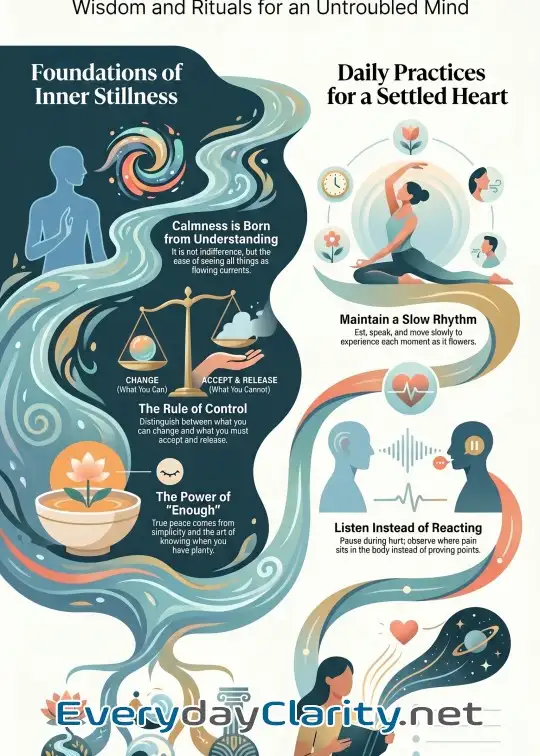
Calmness is the gift of someone who has walked through storms-and still kept a light burning in their heart.
1) Opening: the art of an untroubled mind
In a world that spins on gain and loss, winning and losing, there is a quiet beauty that only a settled person can truly touch: calmness.
Calmness is not indifference, and it is not giving up. It is the ease of someone who has understood impermanence at depth. When you see clearly that all things are merely flowing currents of conditions arising and passing away, the heart no longer has any reason to rush.
A calm person does not avoid rough seas; they simply learn how to breathe in the middle of the storm. They do not try to erase suffering; they smile at it like an old acquaintance-because they know that every pain can become a teacher on the path of wakefulness.
When there is understanding, calmness comes naturally.
When there is calmness, clarity comes naturally.
When there is clarity, love comes naturally.
2) The philosophy of calmness across wisdom traditions
(a) Buddhism-calmness is born from non-attachment
The Buddha taught: there is nothing that can truly be called 'me' or 'mine'. The calmness of one who understands the Way is not coldness; it is love without clinging-loving without possessing, giving without needing anything in return.
A calm person watches flowers bloom without hurrying to rejoice, and watches them fade without sinking into sadness-simply seeing all phenomena as they come and go according to conditions. When the mind no longer fights the current, every upheaval becomes a practice.
Between blooming and fading-there is only the flower: nothing added, nothing taken away.
(b) Lao Tzu-effortless action, complete in itself
Lao Tzu said: one who follows nature becomes one with the Tao. Calmness, in this spirit, is non-striving-no competing, no grasping, no forcing.
Water is soft, yet it can pass through hard rock. Birds fly without leaving tracks; rivers flow without needing to ask the way.
One who follows the Tao lives like water: quiet, gentle, and yet boundless in strength and compassion. They do not need to control life, because they understand that everything is already in its rightful place.
'Do nothing, yet leave nothing undone'-this is the Way of letting go.
Meaning: change the inside, not the outside.
(c) Confucius-the Middle Way and balance
Confucius taught: the doctrine of the mean is a great virtue of Heaven and Earth. The calmness of a noble person is not absolute stillness, but balance-between emotion and action.
The noble person can be joyful without dissolving into indulgence; they can be sad without losing their direction. Amid prosperity and decline, gain and loss, they keep the heart from tipping to either side-like scales that always return to the centre.
'One who knows contentment is wealthy; one who accepts their proper place in the Way is honoured.'
(d) Greek philosophy-Stoicism
The Greeks called it ataraxia: a mind that cannot be disturbed. The philosopher Epictetus said:
It is not events that trouble us, but our view of them.
Stoicism teaches us to distinguish clearly between what lies within our control and what does not. What you can change-act with all your strength. What you cannot change-learn to release it and accept.
Marcus Aurelius, the meditating emperor of Rome, wrote in Meditations:
If it belongs to nature, let it unfold according to nature. If it does not belong to you, do not let it rule you.
Calmness in the Stoic spirit is absolute inner freedom-a mountain that does not move even when the wind changes direction.
(e) Epicurus-calmness through simplicity
Epicurus did not promote indulgence. He taught people to find joy in simple things: a plain meal, a sincere friend, a night sky full of stars.
No one is poor because they desire little; they are poor because their greed has no bottom.
In Epicurus' philosophy, calmness is the art of knowing what is enough. When we stop chasing what is outside, happiness rises naturally from within.
3) Practice: nurturing a calm way of life
1. Breathe as a ritual
Each morning, give yourself a few minutes simply to breathe deeply.
Breathe in-feel Life entering you.
Breathe out-release the worries that do not need to be carried.
Silently say:
Today, I choose calmness.
2. Keep a slow rhythm in a hurried world
When the world runs fast, one who understands the Way chooses to move slowly:
- eat slowly, to taste;
- speak slowly, to hear yourself;
- live slowly, to see each moment flowering.
3. Listen instead of reacting
When someone hurts you, pause.
No need to react. No need to prove anything.
Just breathe-and observe where that pain sits in the body.
That is where wisdom begins.
4. Gratitude-the root of calmness
Each evening, write down three things you are grateful for today.
Gratitude is a bridge between the heart and the Universe. It is the soil in which the seed of peace can sprout.
5. The art of not knowing
A calm person does not need to know everything. They have the courage to say: 'I don't know'-and let that be enough.
For in not knowing, the mind stays open to learn.
4) Calmness-the heart of one who understands
A calm person is not unfeeling. They feel deeply-only they are not swept away.
They know that everything appears for a reason, and every disturbance leads to one destination: wakefulness.
Calmness is not the result of strain; it is the natural consequence of understanding. When we see impermanence clearly, understand conditions and causes, and accept the dual nature of life, what remains is a bright stillness-like a lake whose surface does not ripple.
Control what you can control.
What you cannot control-do not let it consume you.
And if you can only control part of it-remain calm.
Hoàng Nhật Minh
Excerpt from the book: Spiritual Science - A Journey Back To Your True Self
| Previous Ebook | Next Ebook |
Tags: ProsperityFightsGreeksBurningDesireConfucius
 Practice 16: Slow Living - Living Truthfully - Living Simply (Hoàng Nhật Minh)
 Reflection 35: Awakening (Hoàng Nhật Minh)
 Reflection 36: The Invisible One (Hoàng Nhật Minh)
 Reflection 37: Beyond Cause And Effect (Hoàng Nhật Minh)
 Reflection 38: God Is Everywhere (Hoàng Nhật Minh)
 Reflection 39: The Great Unity Society - When Heaven Returns (Hoàng Nhật Minh)
 Level 5: Freedom (Hoàng Nhật Minh)