


PRACTICE 02: STILL MEDITATION - BALANCED LYING MEDITATION - VIPASSANA
Author: Hoàng Nhật Minh
Views/Listens: 155
Created: 2026-05-03 20:48:49
Updated: 15:53pm 04/05/2026
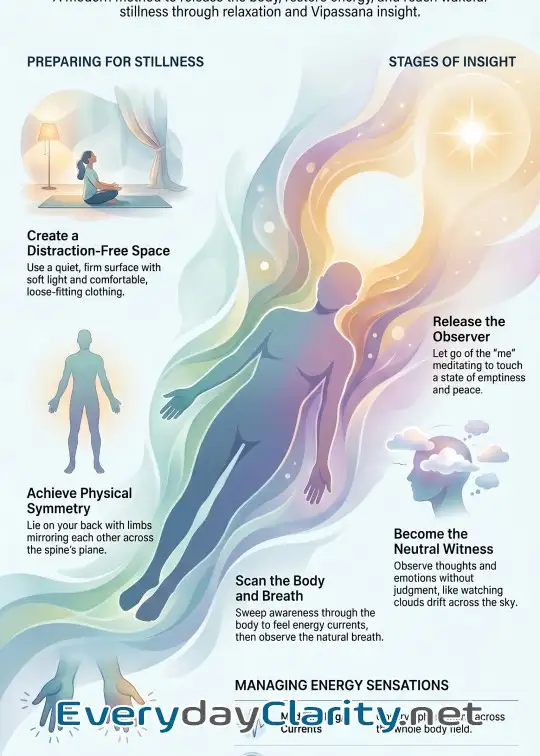
I listen to the breath as it comes and goes like waves on the shore.
No forcing, no resisting-only seeing.
Every sensation arrives and passes like clouds crossing the sky of Mind.
In that absolute quiet, I recognise: the observer and the breath were never two.
I) Overview
Meditation is not only for those who can sit cross-legged. Meditation is a state of knowing-where body and mind are allowed to rest in silence.
If seated meditation helps us turn awareness inward, lying meditation offers a gentler way to release the whole body-so that life energy can heal itself and restore its natural order.
When combined with Vipassana (insight meditation), lying meditation becomes a doorway back to nature: we observe and let go at the same time; we are awake while sinking into deep relaxation. It is a method for this new era-when people need stillness without withdrawing from life.
The breath is the bridge between body and mind. When the breath is at peace, the mind becomes bright.
II) Philosophical foundations
1) From awareness to letting go
Vipassana trains us to see clearly the arising and passing of all phenomena. Lying meditation trains us to soften and accept what is, exactly as it is.
When awareness is joined with letting go, we do not fall into sleepiness, and we do not tense up.
This is the balance between wakefulness and rest-between clear knowing and gentle dissolving.
2) Letting go of the observer as well
At first we often pide ourselves into the observer and the observed. Yet at a certain stage, even the observer must be released.
There is no longer "I am meditating"-only life, moving as it moves.
Then the mind returns to a state of non-abiding: at ease, free.
III) Preparing to meditate
1) Space
- Choose a quiet place with soft light and a comfortable temperature.
- Lie on a flat surface. If you use a mat, make sure it is firm so the spine can remain aligned.
- Place a thin towel under the head (many people fold it into four), adjusting for your own comfort.
- In the beginning, gentle meditation music can help (sounds of water, wind, chimes, frequency music, etc.).
- Wear comfortable, cool clothing with nothing tight or irritating.
- Put your phone on silent and clear away anything that could distract the mind.
Practical tip: bathe before meditating if you can. Adjust your clothes so you feel most comfortable-for example, straighten the waistband, pull your top down over it so your abdomen and lower back do not get cold, and loosen any fabric that pulls or creases. Avoid socks.
If you use a blanket, do not drape it over bare feet: the skin touching the blanket can create tactile feedback that becomes distracting. If you use a standing fan, avoid directing it straight at the body. Remove any watches or jewellery that feels restrictive.
2) Posture
- Lie on your back.
- Rest the arms alongside the body; let the palms soften.
- Keep the legs about shoulder-width apart-neither too wide nor too narrow. Find the position that feels naturally balanced.
- Adjust the shoulders, then elbows, then arms. Spread the fingers fully once, then let them curl back naturally.
- Let head, shoulders, and back rest on the same plane; release the neck.
A useful method: gently lift and set down the hips, then the back, then the head-two or three times each-to find your most balanced position.
Close the eyes lightly. Let the mouth hold a faint smile-as if grateful simply to be alive.
Also minimise unnecessary touch points. Raised folds in the blanket or mat can produce waves of tactile signals-hot/cool, rough/smooth, wet/dry, itchy, pressing, pulling-that scatter attention.
After you have adjusted the posture, you may lightly shake or vibrate the limbs for a moment, then stop and allow the body to settle into symmetry (left and right mirroring each other across the plane of the spine).
Release all muscle groups that are still active, letting the body fall heavy-like a corpse. As much as possible, avoid letting body parts touch (for example, the fingers brushing one another).
Then try this training cycle: gently tense the muscles of the whole body (slowly-and remember the body has many muscle groups). When you can tense nearly all of them, begin the reverse cycle-releasing them one by one into complete relaxation. (The body, like consciousness, often evolves through experiencing both polarities.)
3) Inner attitude
No grasping. No expectation of achieving anything.
Simply be here, listening to each breath-allowing the body to rest and the mind to brighten.
IV) The four stages of lying meditation (Vipassana)
1) Knowing the body
Before you begin, take three deep inhalations and gentle exhalations to release stale air and make entry into meditation easier.
A guiding principle: where attention goes, energy and blood flow follow.
During meditation, spread your attention through each part of the body and sense the energy in the area it passes through. If sensation is difficult, lightly engage the muscles (very gently) to increase feeling.
With practice, widen attention to include the whole body-leaving nothing unlit by awareness. Sense the body filled with energy. If you remain comfortable, you can increase the intensity of attention on the whole body (a little more muscle tone) to create gentle pressure. Stop when you begin to feel slightly taut.
Observe the bodily phenomena happening across the whole field. At this stage, some people experience a feeling like tiny currents under the skin-wriggling, zig-zagging, like electricity, sometimes with mild itchiness.
A note of care: when a large amount of energy enters, the inner "frequency" may rise-bringing increased pressure in blood vessels, in the skull, or in other parts of the body. Acclimatise gradually. If the pressure becomes too intense, reduce attention and simply maintain a steady, neutral state, allowing energy to nourish the body and clear the meridians. As blockages release, the sensations become far more comfortable.
When you can guide attention well, practise like this:
- Let awareness sweep through the whole body like a flowing river.
- Move from the toes → abdomen → chest → shoulders → arms → neck → crown of the head… or in reverse (or in any order you prefer).
- Feel every subtle current moving within.
If you notice numbness, heaviness, lightness, warmth, coolness, tingling-simply know it.
2) Knowing the breath
When the whole body is saturated with energy, you may feel as if the body has disappeared. At that point, you no longer need to focus on the body. Relax completely and bring attention to the breath.
Rest the mind on the in-breath and out-breath. Do not control. Do not count. Just observe, like someone watching wind move through leaves.
Breathing out-know you are breathing out.
Breathing in-know you are breathing in.
Gradually the breath becomes so fine it seems to vanish. You may notice it growing lighter and lighter, and hear the heartbeat slowing.
You enter deep relaxation. Here, even the breath no longer needs to be "held" by mind. Release completely. Let everything unfold naturally, and simply witness.
3) Becoming the witness
When a thought appears-I am thinking…-or when an emotion rises, or an itch or restlessness arises in the body, simply observe.
Recognise without judgement. Do not chase it away, and do not follow it.
Whatever is born will also die. You are the one who witnesses that birth and death-like someone standing on a riverbank, watching clouds drift across the water.
4) Letting go of the witness as well
Observation is like the body and the breath: when everything returns to natural balance, deliberate attention is no longer necessary.
With sustained practice, witnessing becomes as effortless as inhaling and exhaling-gentle as flowing water and drifting clouds. That is the moment when even observation can be released.
Let go of the notion that you are meditating.
No "me". No object.
Only stillness and peace.
This is the meeting point of lying meditation and Vipassana-and also the moment you begin to touch the point of emptiness: the inner space of the soul, where wisdom begins to sprout, bloom, and bear fruit.
Your energy and the energy of the universe begin to mingle. There may be strong bodily shaking; there may be unusual bliss; there may be large ideas arising; or there may be a moment of awakening-suddenly understanding something you could not understand before.
Many things may occur, depending on each person's conditions. Your work is simple: relax, and allow everything to flow naturally-without clinging, without grasping-only knowing.
V) Bringing it into daily life
Meditation does not end when you open your eyes. When you stand up, carry this breath into whatever you do:
- When washing up, simply know you are washing up.
- When walking, simply know you are walking.
- When working, simply know you are working.
Little by little, every action becomes living meditation-and you realise: meditation is not in a posture, but in the state of Mind.
VI) Notes and experience
- Do not force yourself to stay awake-let awareness be natural.
- If you fall asleep during lying meditation, that is fine: the body is being healed and resting in balanced energy.
- Practise regularly for 15-30 minutes each day, and you will notice the body balancing, the mind lightening, and the intellect clearing.
VII) Conclusion: meditation is returning
When the body releases, the mind brightens.
When the mind brightens, the body heals.
When there is no longer anyone meditating, only life remains-meditating itself.
Lying meditation (Vipassana) is not a method for achieving something. It is a path of returning to yourself.
Guided video: Balanced Lying Meditation: https://surl.vn/ivj
Hoàng Nhật Minh
Excerpt from the book: Spiritual Science - A Journey Back To Your True Self
| Previous Ebook | Next Ebook |
Tags: JoinedWitnessesAttitudeFabricRememberPressure
 Reflection 09: Transforming Karma (Hoàng Nhật Minh)
 Reflection 10: Fear - The Mind’s Illusion (Hoàng Nhật Minh)
 Reflection 11: When The Mind Reacts To Outer Circumstances (Hoàng Nhật Minh)
 Reflection 12: Before Practice, We Cling In Worldly Ways; After Practice, We Cling In Spiritual Ways (Hoàng Nhật Minh)
 Reflection 13: The Law Of Balance (Hoàng Nhật Minh)
 Reflection 14: Wealth Is A Contented Heart (Hoàng Nhật Minh)
 Reflection 15: Acting Without Attachment (Hoàng Nhật Minh)