


REALISATION 33: THE STATES OF THE EMPTY MIND
Author: Hoàng Nhật Minh
Views/Listens: 109
Created: 2026-04-06 23:00:11
Updated: 14:58pm 04/05/2026
A meditator asked the teacher:
- 'Teacher, I have searched for so long and still I cannot find the truth.'
The teacher smiled, pointed to the water in the lake, and said:
- 'Can you see your reflection?'
- 'Yes.'
- 'And if the surface is stirred into waves, can you still see it clearly?'
- 'No.'
- 'When the water is still, the reflection appears exactly as it is.'
Truth is not somewhere far away-it is simply hidden behind the waves of the ego. When the mind is quiet, everything reveals itself.
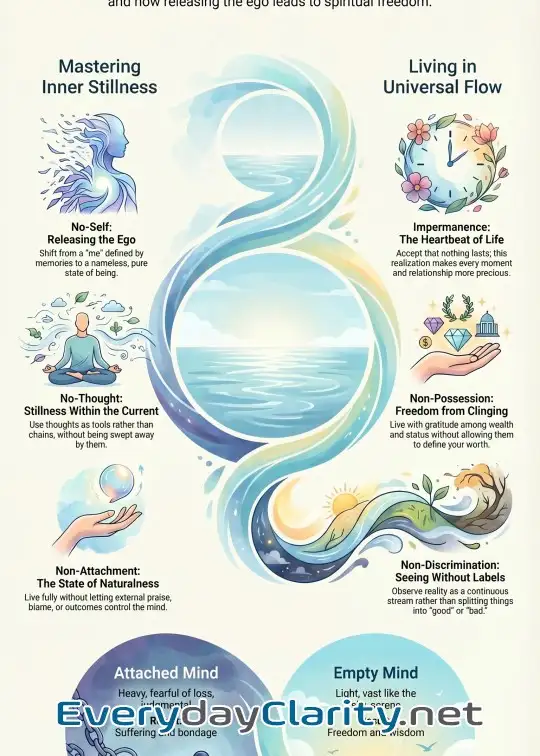
1) No-self - no longer "me", only the stream of life
No-self does not mean there is no person. It means we are no longer identified with the temporary ego.
The "me" we struggle to protect is only a bundle of memories, emotions, opinions, and fears. When we release that "me", we return to simple I AM-pure being: formless, nameless.
'One who sees no-self, sees the Way.'
*(The Buddha)*
When there is no longer a "me", judgement, rivalry, and suffering dissolve. The mind becomes like the sky-receiving every cloud, holding on to nothing.
2) Non-possession - no clinging, because everything belongs to the Dao
In this universe, nobody can truly own anything-not even their own life. When we cling, we fear loss; and when we fear loss, we lose our freedom.
One who understands the Way lives among wealth without being ruled by it, among status and gain without allowing them to define their worth.
The more we call "mine", the heavier the burden. The lighter we are, the nearer we are to the sky.
Non-possession does not mean renouncing life. It means living in gratitude without attachment.
NON-POSSESSION (Hoàng Nhật Minh)
The ten thousand things of this world-none can be owned.
Gain and loss are weightless, like a wisp of down.
If suffering remains, it is because we cling.
At ease and unbound, the mind contemplates the mind.
3) Non-staining - living in the world with a clear mind
In a world full of dust, the awakened person still releases fragrance, like a lotus.
Non-staining is not escaping life. It is moving through life with a bright, clean mind. Praise and blame, gain and loss, coming and going-mere breezes passing over a still inner lake.
One who is unstained does not deny emotion, but allows it to pass through without letting it take command.
NON-STAINING
Life's scenes are many; they irritate the eye.
Things not your concern-yet you rush to interfere.
That is the mind still tangled in attachment,
Fear beneath the surface, a restless heart.
Look on the world with openness; let the mind be kind.
Hold all things in spaciousness-do not complain.
When the mind is settled, wisdom rises; all becomes clear.
Light and vast, you see the lotus-golden and serene.
Hoàng Nhật Minh
4) No-thought - stillness within the current of thinking
The human mind is often as restless as the sea: it finishes one thought about the past only to worry about the future.
No-thought does not mean never thinking. It means thinking without being swept away. When the mind abides in the present, thought becomes a tool rather than a chain.
A thought arises, yet the mind does not stir.
A notion appears, then fades-like clouds crossing the sky.
When the mind does not cling anywhere, every thought dissolves by itself-and wisdom is born of itself.
5) Impermanence - the ceaseless flow of life
Nothing in life lasts forever. Things, feelings, relationships-all are like water running through the fingers: impossible to grasp.
Impermanence is not a tragedy; it is the natural heartbeat of the universe.
Because of impermanence, flowers bloom and fade, yet spring returns.
Because of impermanence, pain dissolves and joy can arrive.
If everything stood still, life would become an endless sleep-without suffering, perhaps, but without growth.
We suffer because we want to keep what cannot be kept. When we love, we want it to remain like today; when we succeed, we fear losing it tomorrow. Yet the fear of loss is already loss-born the moment fear arises.
Only when we accept impermanence can the heart settle in the present-the only place life truly exists.
Everything will pass.
Only compassion and wakefulness remain.
When we look through the eyes of impermanence, we see how precious everything is: a shower of rain, a smile, a hand held. Because we know it will not last, we cherish it more, love more deeply, live more truly.
Impermanence takes nothing away-it simply makes space for the new to be born. The old dissolves so the new can appear, like the out-breath making room for the in-breath.
Life never disappears; it only keeps changing form, learning again and again how to love.
Whatever is born will also perish-and that is what we call impermanence.
6) Desirelessness - when craving dissolves into stillness
Desire is not only sensual craving. It is every demand, insistence, and wanting of the mind.
When the mind feels lacking, it always wants more. When the mind is enough, it naturally becomes quiet.
Desirelessness does not mean suppressing desire. It means seeing the root of wanting so clearly that it dissolves on its own-like mist melting in the morning sun.
The Buddha taught:
Craving is the source of samsara, the cord that binds the mind.
Desirelessness is the state of a fulfilled mind: not feeling deprived because it has little, not becoming greedy because it has much.
One who is free of desire does not step out of the world; they live in the world with a relaxed heart. They still love, still act, still create-but they do not seek possession or cling to outcomes.
Joy comes from the action itself, not from success.
It is not leaving the world behind, but ceasing to search for happiness in the world.
*(An ancient Zen saying)*
7) Non-discrimination - when the mind stops labelling life
One afternoon you return to an old café and order a favourite dish-the one that made you exclaim how delicious it was last time. But today it tastes bland, nothing like before. You feel disappointed, annoyed, perhaps even blaming the cook.
The discriminating mind lives on memory. When it compares the present with the past, it manufactures its own suffering.
It is the same with a piece of music: the first time it may move us to tears, but the next time the feeling is gone. It is not that the music has lost its power-it is that the mind has decided it must be the same as before. When the expectation is not met, we suffer. That is the quiet mechanism of discrimination.
Discrimination is a habit of the mind: it splits everything into pairs-gain and loss, tasty and awful, good and bad, happiness and suffering.
But reality has no hard boundary-only one continuous stream of life. When we judge, we see through a narrow frame. When we release discrimination, we see the whole.
Non-discrimination does not mean being mindless. It means having the wisdom to see a truth beyond opposites.
A flower blooms-simply blooming.
Rain falls-simply falling.
No need to praise. No need to blame. Only presence.
It is like a bodhisattva: seeing that beings differ in capacity, yet holding no pision in the heart.
Non-discrimination is not not-knowing; it is knowing without labelling.
8) Non-attachment - when the mind returns to the natural
Attachment is grasping-and whatever grasps will, sooner or later, become tired.
A person who still clings, even to goodness, is not yet truly free. Because clinging to goodness is also a form of fearing evil; clinging to being right is still not seeing the whole of being wrong.
Someone praised as "talented" may later receive criticism and immediately feel inner waves. It is not that the criticism is heavy-it is that we are attached to the image of "I am good" that others once gave us. When the reputation is shaken, the mind hurts.
That is attachment-and attachment is the cord that binds us to suffering.
Non-attachment does not mean coldness or indifference. It is not avoidance, and it is not giving up.
Non-attachment is living fully with whatever happens, without letting anything control the mind.
Like a lotus in the mud: it does not hate the mud, and it does not stick to it. It grows, it gives fragrance, it is beautiful-without needing to prove it is "clean".
Non-attachment is also the state of absolute naturalness. Nature does not strain to become anything.
Water does not try to flow-it simply flows.
The sun does not try to shine-it simply shines.
When we are no longer attached to "who I must be", we return to the freedom and clarity that have always been our true nature.
The wise do not try to bend the world to their will; they follow the world in order to understand Heaven's Way.
9) The Infinite - returning to the boundless source of light
Across religions, "the Infinite" is the beginning-point of "the finite": what is before light, before time.
One who reaches the Infinite no longer sees a separation between God and human being, because they understand that every form is only an expression of one Source.
One root scatters into ten thousand branches; ten thousand branches return to one root.
*(Cao Đài)*
The Infinite is where all the "no-" states dissolve together-no-self, non-staining, no-thought, non-discrimination…-and only pure Being remains, knowing itself.
While there is hoping, there is craving, there is suffering.
While there is delusion, there is imagination, there is samsara.
When there is no worry, no argument, no forcing-
no anxiety, no thinking, no needing-then it is so.
10) Conclusion - the path of Emptiness is the path of freedom
From no-self to the Infinite is a journey of removing layer after layer of illusion.
We think we are losing ourselves, yet in truth we are only losing what is false, in order to return to what is real.
In the state of Emptiness, we are no longer anyone-and we are also everything.
There is nothing left to attain, because everything is already present.
Emptiness is wholeness: empty, and yet overflowing.
Hoàng Nhật Minh
Excerpt from the book: Spiritual Science - A Journey Back To Your True Self
| Previous Ebook | Next Ebook |
Tags: TangledManufacturesFavouriteSurfacePossessionPointed
 Realisation 02: On Religious Discrimination (Hoàng Nhật Minh)
 Realisation 03: On Gender And The Roles Of Men And Women (Hoàng Nhật Minh)
 Realisation 04: On Good And Evil (Hoàng Nhật Minh)
 Realisation 05: On Vegetarian And Non-Vegetarian Eating (Hoàng Nhật Minh)
 Realisation 06: On Money And The Currency Of Happiness (Hoàng Nhật Minh)
 Group 2: Realisations On The Human Condition (Hoàng Nhật Minh)
 Realisation 07: On Suffering (Hoàng Nhật Minh)