


PRACTICE 08: INSIGHT MEDITATION
Author: Hoàng Nhật Minh
Views/Listens: 107
Created: 2026-05-03 21:12:43
Updated: 15:54pm 04/05/2026
1) Why practise Insight Meditation?
Meditation has two main directions:
- Calming meditation (samatha)-to settle the mind;
- Insight meditation (vipassanā)-to see clearly the nature of mind and phenomena.
If calming meditation is like water becoming so still it no longer ripples, insight meditation is the moment you realise:
Waves have never been other than water; movement and stillness are two faces of the same ocean.
Insight meditation is not about reaching a special state. It is about seeing through what is already here-so you understand that suffering and happiness, gain and loss, are only waves on the surface of the Heart. And when you see their true nature, you are no longer swept away.
The mind has no form-neither within, nor without, nor in-between. - Bodhidharma
2) From contemplating the body to contemplating the mind
The Buddha taught the Four Foundations of Mindfulness: contemplation of the body, feelings, mind, and dharmas.
We begin with what is coarse (the body), and gradually move to what is subtle (the mind).
Contemplating the body - seeing the body as a flow
Sit quietly. Observe the breath moving in and out. Feel each region of the body.
See clearly that every sensation is only a stream of energy arising and passing away-there is no separate "me" who is in pain, who is breathing.
The body is simply the flow of the four elements: earth, water, wind, and fire.
When you see this, attachment naturally loosens:
I am not this body.
The mind cannot be seen with the eyes; but the moment discursive thought is released, the mind is revealed. - Bodhidharma
Contemplating feelings - seeing sensations as temporary guests
When emotions arise-joy, sadness, anger, fear-simply know:
- This emotion is arising.
- This emotion is passing.
Do not chase it. Do not resist it.
Emotions are like clouds: they come, they go, they change shape-yet the sky remains the sky.
When you see this, suffering is cut in half.
Contemplating mind - seeing the mind as open space
To contemplate mind is to look straight at the one who is thinking.
When a thought arises, ask gently:
- Who is thinking?
- What is worrying?
Do not search for an intellectual answer. Simply look directly into the place where the thought begins-and it becomes quiet at once.
Because there is no solid "someone" there. This is seeing your nature: recognising that the mind is empty yet luminous-spacious, clear, and aware.
As Bodhidharma said:
The mind has no form. It neither comes nor goes. It neither arises nor ceases.
3) A clear method of practice
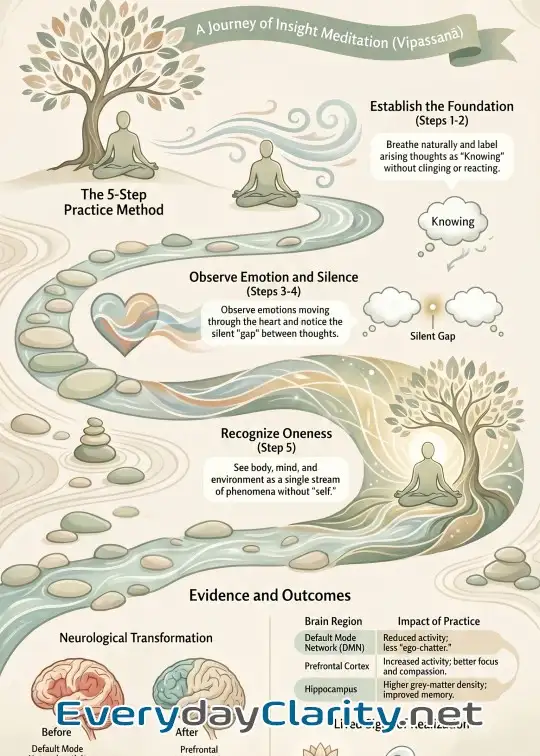
Step 1 - Sit in the breath
Sit comfortably, with a straight spine and softly closed eyes.
Breathe naturally; do not strain.
Know each in-breath and out-breath as gently as waves arriving on the shore.
Whenever the mind scatters, return to the breath.
Step 2 - Notice the arising of thoughts
Whatever thought appears, silently say: Knowing.
No need to push it away; no need to follow it.
When you know without clinging, the thought drops by itself-like a dry leaf falling.
The less you react, the brighter the mind becomes.
Step 3 - Contemplate emotion
When discomfort appears, do not try to banish it.
Smile to it: Hello, fear. Hello, sadness.
Simply observe how it moves through the body, through the heart.
See clearly that there is no "person" suffering-only emotion passing through.
Step 4 - Contemplate the Heart
Now notice: is there any gap of silence between thoughts?
That gap is the true Heart-still yet bright; empty yet complete.
Rest there, even for a few seconds.
Do not hold it; do not grasp it-just recognise it.
This is the "no-thought" Zen speaks of.
Step 5 - Contemplate dharmas: seeing all as One
When contemplation matures, you begin to see that body, feeling, mind, environment, people, and things are one stream of phenomena unfolding.
There is no longer inside and outside; no longer self and other.
This is the dharma-realm shaped by mind, and the wisdom of oneness.
4) Combining Insight Meditation and science
Modern research shows that Insight Meditation can:
- reduce activity in the brain's default mode network (DMN)-the system that constructs the sense of "me";
- increase activity in the prefrontal cortex, supporting attention and compassion;
- increase grey-matter density in the hippocampus, strengthening memory and emotional stability.
From an energetic perspective, when the mind becomes quiet, the body's vibrational frequency rises. That is one reason experienced meditators often appear brighter, lighter, and healthier.
5) Common mistakes
- Trying to force bliss → only creates more craving.
- Trying to destroy thoughts → only creates more agitation.
- Comparing your progress with others → a new form of attachment.
Remember:
Meditation is not about forcing the mind to be still. It is about seeing clearly the mind in motion.
There is no need to search for stillness-because stillness has always been present within movement.
6) Lived signs of realisation
When you practise insight correctly, you may notice:
- Life seems to slow down, yet the mind becomes brighter and clearer.
- Emotions come and go like gentle waves.
- Everyone and everything has a place within your heart-no one is excluded.
This is when heart and wisdom become one: the heart is bright, the tenderness deepens, and the body feels light.
Bodhidharma taught:
In a single thought of awakening, ten thousand kalpas of delusion are dissolved.
Do not eliminate delusion; do not seek truth.
Know the Mind as Buddha-this is the Way.
7) A practice mantra
Do not cling to anything.
Do not reject anything.
Just look-just know-just be.
When the Heart is still, all things naturally settle.
8) Closing words
Insight meditation is not a method for achieving something. It is the art of living deeply in each moment.
When you see through the mind, there is nothing left to "transform"-because the seeing itself is transformation.
The Heart becomes still without seeking stillness.
The Heart becomes bright without seeking brightness.
When you no longer want to "become", that is the moment of wholeness.
Hoàng Nhật Minh
Excerpt from the book: Spiritual Science - A Journey Back To Your True Self
| Previous Ebook | Next Ebook |
Tags: ClosedStrengtheningContemplatingBrighterFoundationsDelusion
 Realisation 06: On Money And The Currency Of Happiness (Hoàng Nhật Minh)
 Group 2: Realisations On The Human Condition (Hoàng Nhật Minh)
 Realisation 07: On Suffering (Hoàng Nhật Minh)
 Realisation 08: On Birth And Death (Hoàng Nhật Minh)
 Realisation 09: On The Meaning Of Life (Hoàng Nhật Minh)
 Realisation 10: On Free Will (Hoàng Nhật Minh)
 Realisation 11: On Destiny And The Larger Design (Hoàng Nhật Minh)