


PRACTICE 05: EATING TO BALANCE YIN AND YANG
Author: Hoàng Nhật Minh
Views/Listens: 108
Created: 2026-05-03 20:56:05
Updated: 15:53pm 04/05/2026
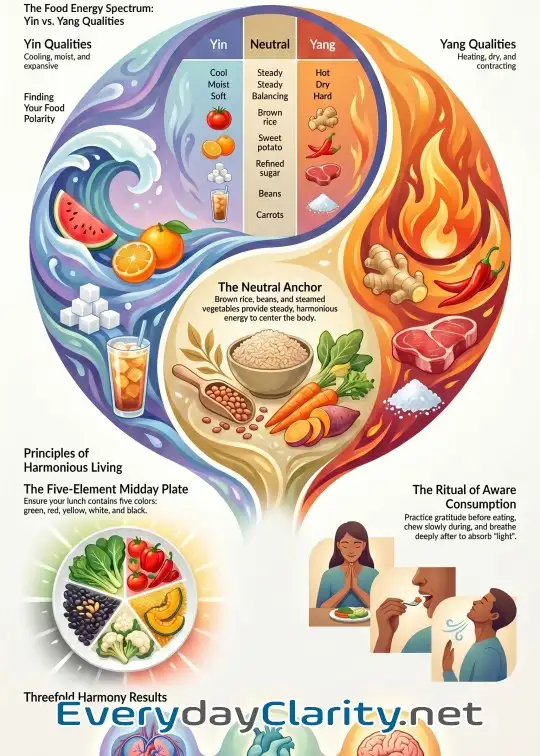
Food does not only nourish the body; it also nourishes the mind and the soul. When we eat with awareness, each meal becomes a prayer for life.
1) Yin and Yang in every meal
All things carry two polarities within them: Yin and Yang-two opposing forces that nonetheless complete one another, like night and day, the moon and the sun, stillness and movement, water and fire. The human body is a little universe; and so imbalance in Yin-Yang eating becomes a deep root cause of many disturbances of body, heart and mind.
- Yin tends towards cold, moisture, heaviness, inwardness and quiet.
- Yang tends towards heat, dryness, lightness, outwardness and activity.
When we eat too much Yin food (cool, moist, sweet, 'refreshing') or too much Yang food (hot, spicy, salty, fried), the body's energy tilts to one side. The result is a skewing of our biological frequency-like losing energetic resonance at the cellular level.
To balance Yin and Yang is to balance the stream of bio-energy-so the body is healthy, the mind is clear, and the soul rests.
2) A scientific view of energetic balance
From a biological perspective, the human body functions as an integrated electro-magneto-chemical system. Each cell operates best when the internal environment (pH, temperature, moisture, ions) is kept in balance.
Food is a source of quantum energy, carrying its own vibration. Fresh vegetables, grains and fruits tend to hold a higher energetic frequency than industrially processed foods. The closer to nature, the more a food retains life's original wave-helping the body resonate with the Earth's frequency.
From a quantum perspective, balancing Yin and Yang is also balancing biological vibration:
- Yang foods (warm, drying) increase oscillation-helpful for those who are 'cold' and lacking energy.
- Yin foods (cooling, moistening) reduce heat and soothe the nervous system-helpful for those who run hot or live under stress.
In the end, everything returns to the principles of resonance and resonant self-regulation.
3) Recognising Yin and Yang qualities in foods
A simple way to sense a food's tendency is to notice its energetic direction.
Yin-leaning foods (cool, moist, soft, expanding, dispersing). Common examples:
- Watermelon, tomatoes, oranges, bananas
- Raw salads, iced drinks
- Refined sugar, beer
Yang-leaning foods (hot, dry, contracting, concentrating). Common examples:
- Ginger, chilli, pepper, onions
- Sea salt
- Red meat, seafood
- Grilled/roasted foods
Neutral / balancing foods (support steadiness and harmony):
- Brown rice, sweet potato, pumpkin, carrots
- Sesame, beans and pulses
- Steamed vegetables
- Baked salt
Golden principles
- Each meal should hold Yin within Yang and Yang within Yin-a living balance, like the Five Elements generating one another on a single plate.
- Cook with moderation: not too raw, not too overcooked; not too spicy; not too cold.
- Eat what is in season, and what belongs to your land-this is what it means to eat in accordance with nature.
4) Eating as a form of meditation
Eating is not only survival-it is a sacred ritual of gratitude. Each grain of rice is the crystallisation of earth, water, wind, fire, sunlight, and the labour of countless beings. If we eat in haste, we absorb restless energy; if we eat in awareness, we absorb the light of life.
A simple mindfulness practice for meals:
- **Before eating**, look at the food and silently say:
Thank you, Mother Earth, and all beings who have helped bring this meal into being.
- **While eating**, chew slowly and feel the taste, texture, and warmth-this is sense-meditation.
- **After eating**, close your eyes for a few seconds, breathe deeply, and say:
This food is becoming light within me.
In that moment, every cell becomes both the one who gives thanks and the one who prays.
5) Balancing body, heart and mind through macrobiotic living
A Yin-Yang balanced way of eating is not a diet-it is a way of living in harmony with nature.
- For the body: supports circulation and digestion, brightens the skin, deepens sleep.
- For the heart: steadies energy, softens emotions, reduces impulsiveness.
- For the mind: improves concentration, intuition, and clarity in thought and action.
When the body is regulated, the heart naturally grows quiet; when the heart is quiet, the mind naturally becomes bright. This is the state of threefold harmony-Body, Heart, and Mind in tune-which all paths of practice ultimately aim towards.
6) Practical daily suggestions
Morning
- Drink warm water with a few drops of lemon, or a pinch of pink salt, to gently 'wake' the stomach.
- Limit coffee, refined sugar, and iced drinks.
Midday
- Eat enough to sustain you, with the Five Elements' colours: green - red - yellow - white - black.
- Include vegetables and whole grains, with a little plant protein; avoid eating in a rush.
Evening
- Eat light, warm and simple-avoid fried foods and cold dishes.
- Drink a mild herbal tea (ginger, cinnamon, liquorice).
By season
- Hot season: reduce overly Yang foods (very spicy, grilled/roasted).
- Cold season: increase Yang-supporting foods (warm, drying).
- Rainy season: favour neutral foods; avoid cold and damp.
7) Eat with love, live in harmony
When we eat with gratitude, each meal becomes a meditation. When we eat with peace, every cell sings the song of life.
Balancing Yin and Yang in eating is not only a nutritional guideline; it is an art of living in harmony with nature-and with yourself.
In the end, the body is a temple, and food is a prayer offered up to life.
You are what you eat.
A good cook is a good doctor.
Hoàng Nhật Minh
Excerpt from the book: Spiritual Science - A Journey Back To Your True Self
| Previous Ebook | Next Ebook |
Tags: FruitsFunctionsInternalMindfulnessVegetablesRefined
 Realisation 41: The Soul’s Perspective (Hoàng Nhật Minh)
 Realisation 42: Love Hidden Behind Wounds (Hoàng Nhật Minh)
 Realisation 43: On Freedom (Hoàng Nhật Minh)
 Realisation 44: On Independence, Freedom, And Happiness (Hoàng Nhật Minh)
 Realisation 45: On Inner Revolution (Hoàng Nhật Minh)
 Realisation 46: On Letting Things Unfold (Hoàng Nhật Minh)
 Realisation 47: Go With The Flow - Stepping Out Of The Game Of Duality (Hoàng Nhật Minh)