


REALISATION 34: THE MIDDLE WAY
Author: Hoàng Nhật Minh
Views/Listens: 98
Created: 2026-04-06 23:00:11
Updated: 14:58pm 04/05/2026
Whatever sits in the middle is called trung - the midpoint, the centre.
Eating is healthiest when it is neither too much nor too little. Temperature is comfortable when it is neither too hot nor too cold; light is easiest on the eyes when it is neither too bright nor too dim; flavour is pleasant when it is neither too salty nor too bland.
That harmony can be called Love, because it is the most easeful point for the body, the emotions, and the human spirit: a state of balance and attunement.
The Middle Way is not about avoiding the two banks. It is about passing through both - while still remaining yourself.
1) Lessons from the extremes
This world is woven from two opposing threads: light and darkness, good and evil, movement and stillness, male and female.
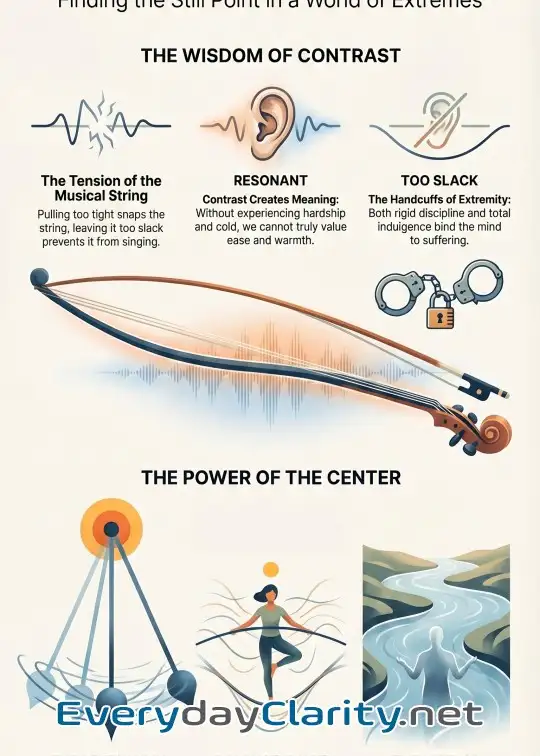
Like a stringed instrument: pull the string too tight and it snaps; let it go too slack and it will not sing. Only by touching both extremes do we discover what is just right.
Imagine a child raised in a perfectly regulated environment - say, a constant 26 degrees C. If you asked that child what heat and cold are, they would not truly know, because they have never experienced contrast.
Without contrast, even comfort loses its meaning. And that child would not feel happy simply because conditions are ideal.
Likewise, a person born into apparently perfect circumstances is not necessarily happy. Without ever meeting hardship, they do not know what ease is; they do not value what they have; they do not live with gratitude. They may also have a lower resilience, because they have had little friction, little rubbing up against life.
On the other hand, those who remain trapped on either bank of extremity have not yet touched freedom or happiness:
- Someone who only clings to rules may imagine discipline is freedom.
- Someone who only indulges may imagine letting go is happiness.
In the end, both discover the same truth: when we are too strict or too lax, the mind is still bound - only the shape of the handcuffs differs.
Some must travel to the furthest edge of pleasure before they see the emptiness inside it.
Some must push austerity to the limit before they realise their heart has dried out.
Only after touching both ends do we recognise that every extreme leads back to suffering.
2) Standing steady between the two banks
The wise do not deny the two banks. They walk between them - balancing on life's thin rope.
They may lean a little left, tilt a little right; it does not matter, so long as the mind remains anchored at the point of balance.
When they are settled in the Middle Way, they can sit with the powerful or the destitute without changing expression.
They can sit with goodness without becoming arrogant, and remain among wrongdoing without being contaminated by it.
They can see themselves on both sides - and therefore they understand, and they have compassion.
The Middle Way is not the path of someone who stands outside.
It is the path of one who can harmonise everything without losing themselves.
That is true freedom: freedom between opposites.
One who abides in the Middle Way has a love wide enough to include both extremes, because they understand that good and evil are simply different stages along the soul's journey of evolution.
Sitting with the good, they help the good understand the perspective of the not-yet-good.
Sitting with the not-yet-good, they help it remember what goodness is.
In this way, they become a bridge between two worlds - reconciling, dissolving pision.
3) Balance - the still point of freedom
Balance is not rigidity.
Balance is the ability to move flexibly, while the mind does not sway.
It is like the pendulum of a clock: it swings back and forth, yet the central axis remains unmoving. The closer we come to that axis, the quieter the energy becomes - and the stronger.
One who walks the Middle Way is not carried away by praise or blame, not shaken by power or adversity.
They can smile in the midst of gossip, stand in the middle of the storm, and remain at peace - because they understand:
There is nothing to gain, and nothing to lose.
4) The Middle Way - the path of Love
The Middle Way is not coldness. It is love that has matured into wisdom.
It is the capacity to look upon life with compassionate eyes: to see that within an "evil" person there is a seed of goodness still asleep - and within a "good" person there is still some shadow to be refined.
If you only love the bright side, that love is not yet whole.
Only when you can love what is not yet bright does love become complete.
The Middle Way is when you can hold everything in your heart without needing to choose.
5) Conclusion
The Middle Way is not for the weak.
It is for the one who has passed through both sorrow and joy - who has fallen into both extremes of life and finally realised: no extreme is the destination.
Such a person no longer needs winning and losing, right and wrong, better and worse.
They simply see, understand, love, and live fully in the present moment.
When there is nothing left to fight, and nothing left to defend, that mind is the Middle Way.
The wise do not stand between two banks.
The wise are the river itself - holding both banks within one body of water.
Hoàng Nhật Minh
Excerpt from the book: Spiritual Science - A Journey Back To Your True Self
| Previous Ebook | Next Ebook |
Tags: DegreesSettledEasiestThemselvesPassedNeither
 Chapter 15: When We Mature (Hoàng Nhật Minh)
 Chapter 16: Becoming One With The Universe - Living As Part Of The Whole (Hoàng Nhật Minh)
 Part V - Synthesis And Opening (Hoàng Nhật Minh)
 Chapter 17: Levels Of Human Awareness (Hoàng Nhật Minh)
 Chapter 18: From Religion To Spirituality - The Journey Home To Yourself (Hoàng Nhật Minh)
 Chapter 19: The Science Of Spirituality - A Civilisation Of The Future (Hoàng Nhật Minh)
 Part Vi - Realisation (Hoàng Nhật Minh)